

NetOwl Extractor
Sentiment Analysis
Entity-based Sentiment Analysis goes far beyond traditional sentiment analysis where “positive” or “negative” sentiment is assigned at the document or sentence level. NetOwl recognizes the multiple, sometimes conflicting, sentiments about entities that may exist within a single document.
Entity- and Aspect-based Sentiment Analysis
Simple approaches to sentiment analysis that classify a text or a sentence as positive, negative, or neutral are of limited value because they can’t capture what the sentiment is actually about.
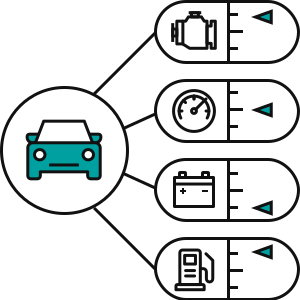
NetOwl offers entity-based sentiment analysis as well as aspect-based (or feature-based) sentiment analysis. At the entity level, NetOwl identifies sentiments toward various types of entities such as people, organizations, brands, and products. At the aspect level, NetOwl captures the specific entity aspects that sentiments are about, for example, the price of a product, the new policy of a country, the campaign of a presidential candidate, etc.
By being able to pinpoint what the sentiment is about, NetOwl’s sentiment analysis is much more informative and useful because it:
- Allows much more detailed sentiment analysis on each entity (e.g., “My iPad speaker does not work.”)
- Captures multiple, conflicting sentiments expressed within a single document or sentence. (e.g., “I really love my car, but its gas mileage is disappointing.”)
Key Product Features

Accurate
Provides state-of-the-art sentiment analysis accuracy even on noisy text.

Extensive Entity Coverage
Handles all types of entities as targets of sentiment – named and non-named entities of major entity types and beyond.

Semantic Disambiguation
Distinguishes semantic ambiguities such as “cool” in “cool wind” vs. “cool car” by utilizing linguistic context.

Coreference Resolution
Resolves co-referring entities, whether they are names, pronouns, definite noun phrases, or events: “the technology company” → “Apple”.

Fast & Scalable
Extremely fast for real-time analysis. Highly scalable sentiment analysis software with Docker and Kubernetes support.

Easy Integration
Easy-to-integrate entity-based sentiment analysis product with a REST API.
Refined Sentiment Ontology
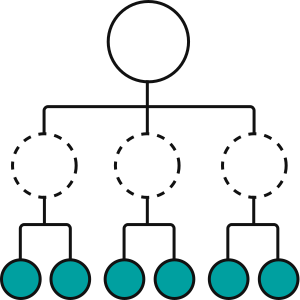
NetOwl’s sentiment analysis tool does not just give “negative” or “positive” binary answers, but offers a more refined sentiment ontology to distinguish different opinions, attitudes, intentions, and behaviors. For example, NetOwl’s fine-grained sentiment ontology makes a distinction between a complaint about a product feature and a threat to boycott a brand.
This kind of distinction will allow organizations to conduct a more in-depth sentiment analysis of opinions and actions. In addition, organizations are able to prioritize and tailor their responses in a much more targeted fashion.
Normalization for Trend and Predictive Analysis
NetOwl’s sentiment analysis software assigns normalized forms to extracted entities (both names and descriptive phrases) and sentiment expressions. It takes into account capitalization, acronyms, abbreviations, nicknames, morphological variants (e.g., number, tense), etc.
This normalization capability is critical to be able to classify, aggregate, and quantify the myriad sentiments expressed in a large data set. NetOwl allows production of much more accurate and meaningful graphs, charts, and dashboards for more effective sentiment analysis, discovery, and monitoring.


Sentiment Analysis Applications
NetOwl’s sentiment analysis has been trained extensively on data from various social media platforms, including Twitter, Facebook, and blogs over many domains. It is useful for many applications, including CRM, online reputation monitoring, market research, online marketing, employee hiring and retention, online review monitoring, election campaigns, public opinion, and geopolitical monitoring.
Deploy on Premise or in the Cloud

Sentiment Analysis Solutions

Social Media Analysis

Adverse Media Monitoring

Intelligence Analysis
Trusted by leading global organizations






Featured Blog Posts

What is Entity-Based Sentiment Analysis?
There is so much opinion data out there, but how do we know what people are actually saying?

How to Choose a Sentiment Analysis Product
Sentiment Analysis can be an effective tool to better understand your corporate reputation or how your products are being received.

Sentiment Analysis Provides Large-Scale, Real-Time Brand Monitoring
In a global and fast-paced economy, monitoring the many aspects that are part of a company’s brand reputation is more…
Discover what NetOwl can do for you!

Schedule a demo
Request a no-cost evaluation
Request our whitepaper