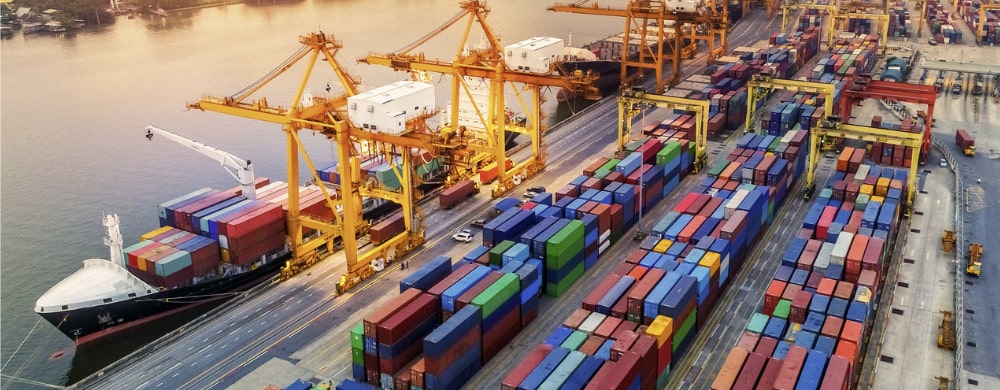
In today’s globalized world, international trading activities have become crucially important. Companies are increasingly internationalized, and there are enormous inflows and outflows of financial investment crossing national borders. Complex global value chains are of central importance to manufacturing now, where the different stages of the production process may be located across different countries. All of this increases the complexity of the business environment that a company has to deal with. Companies operating in this new environment are of all kinds: financial services, banking, retailers, manufacturers, IT and software, travel and hospitality, transportation, logistics providers, aerospace, and defense, and others.
International trading operations can unfortunately also be a major source of risk for companies due to several factors:
- Complex rules that vary widely from country to country regarding import and export controls;
- High penalties applicable to improper international trading activities;
- Institution of complex anti-corruption laws by individual countries related to foreign trade, which includes prohibitions on dealing with certain countries, organizations, and individuals.
All these factors oblige a prudent company engaging in or contemplating a more internationalized strategy to develop strong compliance programs. A critical part of such a program is the screening of prospective and current customers and partners against a variety of sanction lists (such as OFAC) issued by the US, EU, EMEA, and APAC.
Screening against sanction lists is not an easy task. Records may differ in a variety of ways:
- Misspellings
- Word order variations (Park Sol Mi – Sol Mi Park)
- Initials (John Benjamin Harrison – B. Harrison)
- Abbreviations (Street – St.)
- Nicknames (William – Bill/Billy)
The records can also be in English or other languages and language scripts resulting in differences in records caused by transliteration variations (Abdel Hamid el-Morsi vs. Abdul Hameed al-Morsi). The record fields may also contain data other than names: dates, addresses, and a variety of numeric values, all of which need to be accurately matched.
Modern matching techniques have to be robust in the face of all these potential record discrepancies, not only individually, but in combination, must scale to meet today’s Big Data-sized challenges, and support real-time screening.
How Name Matching Meets the Challenge of International Trade Compliance
Name Matching is a critical technology to support compliance. But for effective compliance, Name Matching must support a number of crucial features.
First, it must be highly accurate, minimizing false positives and false negatives. Critical in the context of international trade is being able to handle the differing characteristics of names from all over the world, names that could be from very different linguistic ethnicities, alphabets, and writing scripts.
Second, it must support scalable, real-time matching of potential customer and partner records against sanctions lists.
Third, it must allow the customer to tune the matching behavior. For instance, the system should allow the addition of new nickname equivalents to full given names.
Firms that operate internationally invest in Name Matching. It’s a critical component of a robust compliance plan in today’s highly complex, globalized economy.